
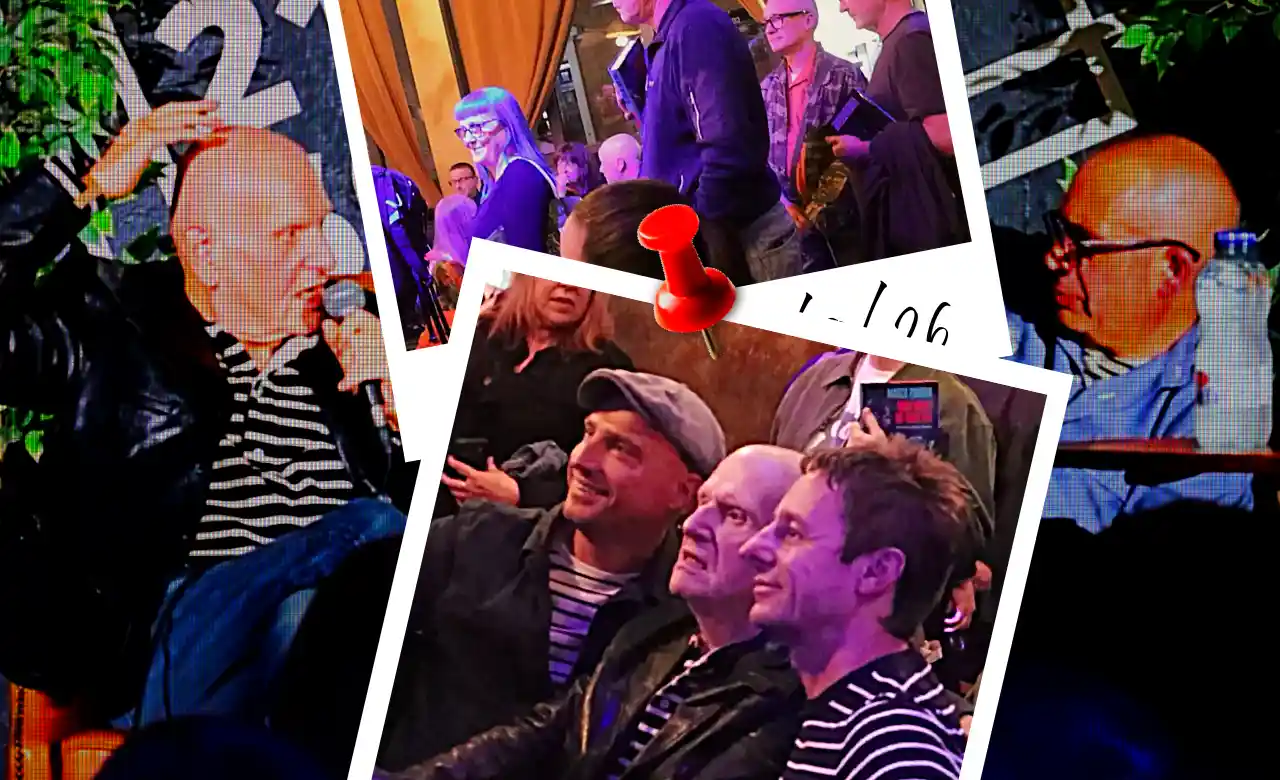
Adam & the Ants guitarist an co-writer Marco Pirroni officially launched his long-awaited memoir Your Money or Your Life at 21 Soho, London on 10th September 2026. Ant Lib was there, and here’s Marco’s full Q&A with the Guardian’s head rock & pop critic (and lifelong Antperson) Alexis Petridis, hosted by Rock ‘n’ Roll Book Club. Your Money or Your Life is available now via all good booksellers, published by New Modern – jump to our review below.
The full transcript:
Alexis Petridis in this font
Marco in this font
Audience questions in this font
Somebody unplug the jukebox and do me a favour (!). Uh, hello. My name is Alexis, I write for the Guardian. I’m going to keep this short because you all know who you’re here to see. When I was nine years old, Adam & the Ants were on Top of the Pops October 1980, doing Dog Eat Dog. I’ve written about this before. It was a performance that completely changed my life. They immediately became my favourite band. They made me the person I am today, for better or for worse. So, it is an absolute thrill – I mean, genuinely a massive thrill – for me to be doing this, talking about this fantastic book [Your Money or Your Life]. Let’s welcome to the stage, its author, Mr. Marco Pirroni.
So pleased you played ‘Antmusic’ (!)
Um, we’re just gonna begin… well, we’re going to begin at the beginning of your life, if that’s alright?
Alright, go on then.
Because you had quite a strange childhood, in a way.
Well, it was a lonely childhood [audience awws].
Really?
Yeah.
You say that your mum and dad weren’t around much because they were working in a restaurant. You also say you didn’t go out much as a kid.
No. Where would I go?
I don’t know! [laughs]
No, I didn’t have any friends. It was just me and my granny in this basement flat. And I just watched television constantly. And in those days, television didn’t really start… It didn’t even have lunchtime news. So, I just watched the test card. [audience laughs] Yeah, I did. I just watched the test card. And in those days, they didn’t have… you know the girl with the blackboard and the clown whatever it was. They didn’t even have that. It was just a load of grey geometric shapes. And I used to watch that constantly from the morning when I woke up until children’s programmes started at 5pm.
You also said that when you first started school, you didn’t really speak English.
No.
Your parents didn’t speak Italian, though. They spoke a kind of… I looked it up and it’s not, the dialect they spoke is not even based…
My dad spoke English and my mum didn’t.
At all?
Well, what happened was that my mum came over and she’d forgotten most of her Italian but she didn’t learn anything to replace it. So, she used to just communicate in this language that I didn’t know. Nobody knew. My dad didn’t understand it [audience laughs].
So, this is a peculiar – as you say – a sort of lonely and peculiar environment in which to grow up. There’s a real sense in the book that your life proper sort of begins – genuinely does begin – when you see Bowie on Top of the Pops doing Starman.
Yeah. Up until that, I was just this sort of meaningless blob. No, you know, I had toys and I watched television and I went to school but I didn’t really know anybody at school. Well, I knew them, I wasn’t bullied or anything like that. But no, until I became a teenager, I wasn’t really anybody.
And why do you think… I mean, lots of people say, “I saw Bowie on Top of the Pops doing Starman, da-da da da da…” You must have gone back and thought about this – why do you think it affected you so much?
Because it was like nothing else. Because it wasn’t. It was otherworldly, as you said earlier. It was completely otherworldly. Like, “What is this, this really is from another planet. This really is the last alien rock star.” I didn’t know what Ziggy Stardust was. I still don’t know what Ziggy Stardust, who he actually is. It was just like nothing else. But I guess there were a lot of things that were like nothing else, but they didn’t affect me.
Did you like music before then?
No [laughs]. I didn’t like rock music or pop music. I liked soundtracks and I liked TV shows. But my life is sort of like… the main thing that runs through my entire life, actually, the main track is the James Bond theme.
Really?!
Yeah. That’s the first music I really… oh no, and I Wish I Was a Spaceman. That’s the first thing I really, really, really, really liked. And I used to go around singing it.
You seem to develop quite strong opinions about music quite quickly. You’re talking about being at school and there being this different school in Harrow…
Yeah.
…and you don’t like anybody from this different school because they’ve all got long hair…
Yeah.
…and they like prog rock. And your own words are: “I already object to prog rock” which is, bearing in mind for somebody that wasn’t into music like five minutes…
You may not remember but some people in here might. There was a sort of look that was like long, lank hair and those awful army greatcoats and like these terrible, sort of really shapeless Brutus jeans and those horrible boots with the zips up the side. And they all wore these and they all walked about with, you know, Yes albums and ELO and Spirogyra. And I hated them. I mean, I just used to have intense loathing of them. I’d see them going to school in the morning and I just used to stare at them like, “I want to kill you. Everything about you is offensive.”
So, is it more the look than the music they like that you object to?
It’s both things. I’ve never heard the music that they liked. I never wanted to hear it.
Right. But you just knew it was bad.
I knew it was bad. I’d take one look at the cover and then take a look at them. You go, “No. No fucking way.” [laughter] But that was the thing about Bowie was the antidote to all that, because that’s all there was. I mean, there really wasn’t any other sort of forms of music. I mean, there was like reggae but like Bob Marley hadn’t even come through yet. And then there was like Motown chartbusters, all those volume one, volume two, and there was soul, reggae and prog rock, but that was it.
So, you talk about the look that accompanied prog rock. Clearly, fashion had already become important to you?
Yeah, yeah yeah.
As a result of what? As a result of Bowie and Roxy?
Yeah. It’s easy, you just want to look like that. Not that I ever really could, but you could take some pointers from it.
You had a brief flirtation with the Teddy Boy revival.
Yeah, yeah, yeah. I didn’t want to be a teddy boy because I didn’t like rock ‘n’ roll but I desperately liked teddy boy clothes. I like the outfit. I like the drapes. I like the shoes. I like the brothel creepers. And the brothel creepers are why we’re having this conversation…
Because the brothel creepers led you to Malcolm McLaren and Vivienne Westwood’s shop.
Yeah, yeah, I was trying to find brothel creepers and you just couldn’t get them anywhere. There was a couple of shops that had… There were a lot of teddy boys around where I lived. And there was a couple of shops that sometimes stocked brothel creepers, but they were always sold out as they only ever got like two pairs in. And so somehow, and I think it was either reading Club International or there was a segment on like that awful Nationwide programme about a teddy boy shop. And it was Let it Rock with these teds hanging around outside it. So, I clocked the address and I went there to buy my… I thought I must be able to get some brothel creepers from there, and I went down there on a Wednesday after school…
In your school uniform…
…in my school uniform [laughter]. The reason I went in my school uniform is because I was desperate to get down there and school ended at 4 o’clock. I could just about get to the station in like half an hour, and then half an hour down on the train just before they closed at 5:30. And that is why I didn’t have time to go home and get changed. So, I just ran down, but I wanted them so desperately. It was completely like a drug and I couldn’t sleep. You know, I used to draw pictures of these shoes in my exercise book [laughs].
You talk a lot about the shop. You talk a lot about, you know, in its various iterations: Let it Rock, Too Fast to Live, Too Young to Die, and SEX. It seems to me, from reading the book – correct me if I’m wrong – the shop is and the clothes are almost more important to you throughout the punk era than the bands are.
Yeah, they are much, much more important! Although the Sex Pistols were absolutely brilliant and they were a life changer, I wouldn’t have been there, I wouldn’t have gone to see the band if it wasn’t for the shop and how they looked. I mean, if they didn’t look how they looked… I mean, if Rotten hadn’t looked like Rotten and he just looked as everybody else, I don’t know what they would have been. It would have been just not very good band. You know, there wouldn’t have been an attitude. There wouldn’t have been a look. They would just be a pub band.
So you’re there in Malcolm McLaren and Vivienne Westwood’s shop, in your school uniform…
Yeah.
…a lot of people, when they talk about the experience of going to that shop, go “It was incredibly intimidating.” I mean, just talk about that. Tell me about how you found it and tell me about what impacted on you so much about that.
Well, I mean, for a start, it was black. It was a big skull and crossbones outside. It was going through a sort of… It said ‘Let it Rock’ outside the shop but it wasn’t Let it Rock, it was Too Fast to Live, Too Young to Die. And there was a leather jacket – Malcolm had got this leather jacket from someone – there was on the back of this leather jacket was all these little light bulbs, and it said, ‘Too Fast to Live, Too Young to Die’. And it lit up and, I don’t know, it smelled great. It was dark. It was absolutely like nothing else. There was nothing else anywhere like it.
You say you still dream about it?
Yeah. A lot of people who went to shop do.
Really?
Yeah, apparently. Yeah, because it was really tactile. And then later on when they brought the rubber in, it smelled of rubber and then they had these pink rubber curtains so the whole shop sort of stank of like rubber and lurex. Well, I don’t know really what lurex smells like, but…[laughter]
There’s an interesting thing that you keep saying in the book that what you’re really interested in is being a pop star. You don’t want to be a musician…
No, no I did want to be a musician because I thought that that bit came first…
Well of course, yeah, part of the route to becoming a pop star. But it’s about that end point for you?
Yeah, well, it was about being on Top of the Pops. I just wanted to get on Top of the Pops.
That’s quite antithetical. Was that quite antithetical to the general mood around punk?
No. No, that’s what most people I knew thought. I mean, if you see the last Bowie concert, the Pennebaker film with the last Bowie concert, you’ll see all these kids in the audience and they’re all thirteen or fourteen, which I was, the same as me. A lot of those kids had just ended up down the SEX shop because they were just attracted… They just wanted to be different, inspired by Bowie.
But they wanted to be pop stars also?
Yeah, because Bowie was a rock star. I mean, there’s no way that Bowie could be an indie act, could he?
No, no. Fair enough. Okay…
There’s no point.
So, you sort of start getting into bands – which we’ll come back to – you are not a great fan, ultimately, of being on stage.
Well, I didn’t know that then.
No, no, no. But you say when you played with Siouxsie & the Banshees at the 100 Club, you weren’t bothered about that at all, which seems kind of mad because you’re going on stage with a band who patently can’t play.
But none of us were bothered about that.
But you were going on stage with a band that can’t play in front of an audience of your peers…
Yeah.
…you’re going to make this thing up as it goes… I’d have been absolutely terrified.
And we’re supporting the hottest bands in London, supporting The Clash and the Sex Pistols. Because we went on after the Subway Sect, who I loved. I thought it was a bit unfair that we went after them, but never mind, we did. No, I wasn’t exactly sure… I didn’t know what I was doing. I mean, I’m only there because Billy Idol didn’t want to do it [laughter]. We went around to his house, and as soon as he saw me, he thought, “Oh, phew! Right, I’ve got this gig to do but I really don’t want to do it because it’s going to be like rubbish and I don’t really like Sue and Steve [Severin] and Sid [Vicious]’s mental, and I can’t play with Sid because I’m really worried about my future career.” I thought, “What the fuck are you talking about?” You’re not going to get anywhere, Billy. It doesn’t matter. But we didn’t… I mean, I knew Sid, I didn’t really know Siouxsie and Steve, and Sid didn’t know Siouxsie and Steve. I don’t know why we did it, but I mean, they did it because Malcolm had said to Siouxsie and Steve, “You’re gonna form a band. You’re going to play and you’re called Suzie & the Banshees.” I think maybe because he said, you know, so what’s the name of your band? And they said, “Well, we don’t know.” And so they saw Cry of the Banshee apparently on TV and they said, “Oh, the Banshees. Suzie & the Banshees.” Which is actually a pretty good name, but they’d done no preparation at all. They hadn’t rehearsed, they hadn’t thought about it, they hadn’t even got any members for the band. They had no songs. They had no experience. They had no instruments. I don’t know what they thought was going to happen. I think they were just hoping that the sun would go nova and that the universe would end and they wouldn’t have to do the gig [laughter]. But it didn’t, and they had to do the gig. And so, we went to the Clash’s place to rehearse on Sunday night. I mean, that’s just ridiculous. And we couldn’t play anything… at all. Nothing. People will say, “Oh, you were really advanced, you were better than anybody else.” That’s because I could tune up. Somehow, I’ve got a good ear and I could tune up, but I couldn’t play anything once it was in tune. I didn’t know anything. I knew bits of things, you know. I knew a bit of Suffragette City and a bit of Ziggy Stardust and a bit of some Velvet Underground’s. I think we tried to play something. I played, and I thought maybe they could play along, and they didn’t. And Sid, I just turned to him and he just looked at me and said, “Oh sod this, let’s just make a noise.” And then he put his drumsticks down and got up and walked out. Then we went to the pub. That was it. That was the rehearsal. “Let’s just make a noise.”
And that wasn’t scary? That wasn’t intimidating?
No, it was easy! [laughs] Because making a noise is the only thing I could do in this sort of Lou Reed ‘ostrich guitar’ type thing. I could do that really well. I couldn’t play anything, but I could do that!
One thing that comes out of your description that – we’ll move on from the punk here in a minute – but I just want to ask you this, is that you were really quite moral in a climate that sort of is quite deliberately transgressive and trying to show you don’t like people wearing swastikas. You’re not mad keen on the Cambridge Rapist thing…
I was 17. I didn’t know what any of this meant. It sounds weird now but I didn’t know Nazis were bad. I just thought they were Germans. You know, it’s like being at school. It’s one of the things that Jane [Savidge] and I talked about when we were doing the book. It’s like, I was at school when I was six, and I used to draw, like, German bombers and put swastikas all over. And when you wanted to blow the bomber up, you just get a red pen and go like that [makes scribbling movement and sound] and make a noise. And I was told I wasn’t allowed to put swastikas on my planes, but no one said why you’re not allowed to put swastikas on planes. And I didn’t know they represent Nazis. I’d never heard of them. Who are these guys? Are they bad? I mean, no one said… I went to a Roman Catholic convent school. They never said anything. And the Cambridge Rapist I didn’t know what that was till I saw it. I thought it was just a funny t-shirt or a good slogan, and I didn’t know what that was until I saw some TV thing about they’d caught him. I thought, “Oh, that’s who he is.” And I do remember asking Vivienne… we were at Louise’s, and I said, “Why did you do a Cambridge Rapist t-shirt?” I was so naive that I thought they actually had reasons for doing these things. I thought there was a thinking behind it, and I don’t think there really was. And she said, “Well, we thought he’d come in and bought the mask in the shop and we felt we had to protect him.” I thought why?! And she said, “Because, you know, nobody’s innocent. And that’s why we wanted… Nobody, nobody is innocent.” Yeah, but, you know, some people are more guilty than others, aren’t they?! So I didn’t know what she was talking about.
But if something that wasn’t moral…
That just it not making sense. You’ve got to remember that I was 17.
Yeah, sure. But you also make that point. You say, you know, I’m seventeen. The people on this scene are really young.
Yeah. 17, 19. The pistols would have been like pushing 21.
But you also say Vivienne and Malcolm are a bit older, and it’s almost like they should know better. Do you feel that they were kind of exploiting a degree of innocence on the part..?
No. No, I don’t think they’re exploiting anything. They were just doing what they thought was good. And there was some thinking behind it. I was always trying to find out what the thinking behind it was. I was always wondered why have you done bondage trousers? Why did you open a rock ‘n’ roll shop at the end of the King’s Road? And in completely the wrong era? And what has, you know, S&M got to do with drape jackets? But it all fitted, it all fitted wonderfully. None of it made any sort of sense, and I thought that maybe Vivienne and Malcolm had some sort of rationale behind it. They didn’t. They just thought this would be good. Which is why another thing I found out in the intervening years is that when I do something like when we did Kings [of the Wid Frontier], it was like, but why did you think this would work? Why did you think that glam rock and Ennio Morricone would work together? We didn’t! We just did what we thought we’d like. We just thought it would be good.
The book kind of hinges, and to some extent, your career hinges on this meeting you have with Adam where he passes his number onto you and so on and so forth. Before we get to that, tell me about your sort of relationship or your thoughts on Adam & the Ants prior to that, because you’d see them live quite a bit…
I’d seen them live a lot of times, actually. About four or five times. First time I saw them was at the Man in the Moon and me and Jordan and Vivienne went to see them, and they were just appalling [audience laughs]. And I mean really, really bad. There was not really one instrument, not one string on stage in tune with another string. And Adam was just going mental. It was a tiny… It was much smaller than this place. I mean, the stage was this big. That’s what it was. And he was just going mental, just throwing himself around and, like pushing everybody over. I don’t know if he had a gimp mask on at the time. People say he did, but I don’t remember. I just thought they were awful. And then Jordan sort of said, “Well, I’m thinking of managing them.” And I didn’t know what to say really [laughter]. I said, “Really?!”. But in those days, because nobody could really afford to rehearse and there were not enough bands to fill venues – there were not enough bands to fill the Roxy – bands got gigs before they could play. So they used to just do gigs and that’s what they would use as a rehearsal. And so they’ve got a lot of gigs in them and they would get better. I mean, that’s not a professional way of doing it. You’ve got to have either confidence or total stupidity to go on stage without knowing what you’re doing and hope for the best. Yeah, it was: we go on stage, we plug in and we hope for the best. That’s how you did it. And so if you do that enough times, sometimes sometimes you start getting good and you start getting better at least. And then I saw the Ants two months later and they’d done, I don’t know how many gigs, maybe they’d done twenty gigs. I couldn’t say, “Wow, they’re really good!”. I’d say “Good, they’re much improved.” And they had a new drummer, Dave [Barbe] played and he was much better than the other guy [Paul Flanagan]. Oh, yeah, the new guitarist. I never liked Mark as a guitarist, and Johnny Bivouac and Dave Barbarossa, and they were like a real band. Or as real as you can get in those days.
So you’re in Rema-Rema and you’re not really enjoying being in Rema-Rema, and that’s kind of petering out anyway.
Yeah.
You auditioned for the Banshees at one point, and then seem to decide midway through the audition you don’t want to do it.
Yes [laughs].
OK! And then you get this message from Adam…
Yeah.
And you go and meet him…
It was sort of like, I think I remember I auditioned for the Banshees on Monday because John and Kenny had run away on Saturday night in Scotland, Aberdeen or something, so on Sunday Siouxsie, Steve and Nils Stevenson drove back. And on Sunday night they called me and said, “Come down to rehearsal tomorrow.” And I went down and it didn’t really work out. I thought they were going to go back and do like kind of Captain Scarlet and kind of poppy punk songs. But they weren’t, they were going to move into this new Canyons of Your Mind post punk era. It was the time of the second album, Join Hands, which has only got one good track on it – Placebo Effect – that was good. I thought, this is not what… I’ve just left a band [Rema-Rema] doing this. I don’t want to do this again. And then Nils said, “Well, y’know, your heart’s not really in it.” And I said, “No, not really.” So, they got Robert [Smith] to do it.
So, you get this message from Adam and you go and meet him. And there’s a long description of this meeting at the start of the book. And he is very clearly bluffing it. And he’s talking absolutely balls…
He always has been! [laughter]
Because he literally says at one point, there’s a brilliant bit where he goes, “Oh, the word around the music business is the Ants are going to be huge!” And it’s like, mate, you haven’t got a band, you’ve been thrown out of your own band. You haven’t got any songs. Who is saying this is going to be big?!
Yeah, well, that’s exactly what I thought. I thought, “No!” I wasn’t even part of the music business. And I thought, “Nobody thinks you’re going to be big. [laughter] Apart from maybe me and I’m not really sure.” Yeah, he said, I remember it. We’re walking across Waterloo Bridge or one bridge… “The word around the business.” What do you know about the word around the business? But anyway, and I always wondered, do you really believe that? Or are you just saying that? Are you trying to impress me or are you trying to impress yourself? And I think he was trying to impress himself. Obviously, he was in a low state, in a sorry state. He’d just been thrown out by three friends out of his own band. I mean, that’s been like being dumped by three girlfriends at exactly the same time.
So, if you’re an astute person, you realise he’s talking absolute bollocks. What made you throw your lot in with him then?
Well, because I thought he was good. And we shared the same ideas. I mean also we had almost exactly the same musical tastes. There was nothing that he’d mentioned that I didn’t like. That’s the first thing he said. He said, “My favourite band’s Roxy Music.” And I said, “My favourite band’s Roxy Music.” And there was a silence and he went: “Oh, okay. Well, good.” Everything he liked, I liked. Apart from he really liked the Doors. I thought the Doors were good, but he was a Doors fan. I wasn’t a Doors fan, but I was a fan of everything else that he was talking about.
The sound you go on to pursue together is extraordinary, absolutely extraordinary. It seems to have come together quite quickly for something that’s got a lot of disparate influences in it…
I guess it was. I’ve never thought about it. It took a couple of weeks in the studio and because there were no recording facilities that we had any access to, we had to just sort of guess. We didn’t know if this would work. We didn’t know if this would be any good, and we certainly didn’t know if it was going to be successful. We had no idea, we were just doing it. Because we thought, well, we like doing it. So we’ll do it, you know, but we never thought about what’s the audience going to say? What audience will there be? You know, what’s our marketing strategy? We never thought of any of that. I mean, Adam did a bit where he had the idea, when he was sort of obsessed with videos. Yeah, we put it together in the studio. We just stuck in all these things that we’ve been talking about. At last, we could actually play them, we could actually record them because we’d been going on about it for months.
We will talk about the recording of Kings in a second, but there seems to have been a moment after you finished Kings of the Wild Frontier, where you are pursuing pop stardom. You don’t want to be signed to Rough Trade…
No, I can’t say that we are pursuing pop stardom. I didn’t know what that meant. But what I think we always used to say: we don’t really know what we want, but we know what we don’t want.
Fair enough. But was there a moment where you sort of thought, “Well, we’ve signed to CBS, what the fuck have we done? We’ve made this record with, like, Burundi drums and twangy guitars.”
No, there was never a moment. No, never. We never second guessed it, really. I didn’t play it and think “This is this is incredible. This is the best thing that anyone’s ever, ever, ever going to do” or anything like that. But I was really proud of it. And when I looked around at other bands, I think this isn’t… And I was trying to find something that was like it, there wasn’t anything, there were no bands around doing this. There was no one else doing this. I mean, I could find lots of things that it was like, but because that’s where we took it from. But there was no rock music like that.
Correct me if I’m wrong, it seems to me that the happiest you ever were in Adam & the Ants was the making of Kings of the Wild Frontier. You seem to have absolutely loved that.
Yeah, yeah, I think yeah, that was the happiest. The second happiest is like doing Top of the Pops, you know. And as our tours got bigger, our second tour, I suddenly thought, “Yeah, I’m really happy.” I don’t really much like performing, but it’s okay. Everything else around it is okay because the first tour – which I can’t remember the name of [Ants Invasion Tour] – was financially okay. And we kind of got the ideas across and it was critically okay. But I mean, every single fucking night there was just a riot. I mean, you just got sick of it. And it’s like, I don’t want to play in front of people. And members of the of the crew have got to stand in front of me, protecting me with the mic stand. I’d rather not do this at all.
And these people that were fighting were original fans of Adam & the Ants who were now horrified by what you were doing?
I’m not sure. I mean, I’d probably have to ask some people who are original fans. I don’t know who they were. I’ve always thought – but I’m not sure – that there was a bunch of original fans who were generally young – 14, 15, 16 – and they’d come along to see Adam & the Ants, whichever incarnation was on. And they’d come to see Adam, and then a bunch of football hooligans or skinheads or whatever they were also turned up to have a fight. And I always wondered, I don’t know why you bought a ticket. You could do this for nothing. You could just go out there, go into the car park and then you kill each other, and then we’ll just come out and just step over bodies. Because obviously you’re having a lot of fun doing that, and I don’t want to impinge on your happiness. [audience laughs] So go out there, kill yourselves, and then we’ll go home. Everybody’s happy: We’re paid. You’re dead. [Much audience laughter] It’s good for us. Good for you. But no, they decided to come in, and it would have been a place about the size of this. Places around this size. So, if you lot all decided to riot…
[To audience] Don’t do that!
No, you’re too old. [laughter] If you decide to throw bottles at me and Alexis there’s not a lot we can do. I mean, we could leap out and try and beat you up, but there’s loads of you. And we don’t have anyone to protect us. Oh, yeah, that’s right, then we got into having to have security as well. This is ridiculous. Why have we got to have security? The reason most people, a lot of people have security is to stop little girls getting their autographs or old ladies getting their autographs. Not to actually protect them from being killed. Unless you’re a president or something. So, anyway, what was I saying?
I don’t know where we were… the whole thing was people are going to attack us and throw bottles and there’s nothing we can do about it.
No, they’re not. We couldn’t fight them. We don’t have a crew to do our fighting for us while we run away.
No no no no no, Marco, this isn’t going to happen. I mean, it’s definitely not (!). We were talking about the level of violence on the first Adam & the Ants tour…
I think I did not get it because the last time I’d been involved in punk, which is like two years previous, there was some violence and quite a lot of nastiness, but not every single night and not the entire audience. So, I’m shocked. The rest of the band was shocked. I mean, Chris Hughes was completely, you know, not familiar with anything to do with punk. He was just, “It don’t get it.” And I think, “You know what, I don’t really want to do this.”
The change point is that performance of Dog Eat Dog, you suddenly are going to attract a very different audience…
Yeah.
Were there still people at the gigs kind of, you know, remnants of that there in amongst the women and girls?
What happened was, we started doing seated venues and most of the original fans sort of stuck by us, I suppose. And they came to seated venues but there weren’t any more skinheads because they’d have to buy a really expensive ticket, and there’s a point where it isn’t really worth it.
Right, so you have this sort of moment at the start of your time with Adam & the Ants, where you’re kind of like, “Oh, is this going to work?” You put Kings of the Wild Frontier out. The single isn’t particularly successful. Then you go on Top of the Pops with Dog Eat Dog.
Yeah.
And that is basically it for the next two years. Suddenly you are fucking huge.
Yeah.
You’re also really young.
Yeah.
You’ve gone from just being this, you know, not a nonentity but…
Nobody.
Well, sort of, to this huge pop star. You don’t have a bank account. You still live with your mum and dad…
Yeah.
What does that do to your head? I mean, that’s quite a dramatic shift.
I didn’t have time to think about it.
Really?
Yeah, because you’re just working all the time. All the time. There was no online, obviously, and I wouldn’t have had time to go to the bank to sign the forms.
Seriously?
Yeah. I mean, it was just 24 hours a day or it was 9am-7pm, and London in those days, England in those days just shut down at 6:30pm. So, there’s nothing you could have done, there’s no way I could have got a bank account. I didn’t know what a credit card was. I keep being offered them, but I didn’t know what they were. And yes, and I’m still living with mum and dad, but I’m hardly ever there. I just sleep in the bed and then get up. I come home at midnight and I get up at 8am.
You had hankered after being a pop star for a long time...
Yeah.
Was it how you thought it was going to be?
Some of it was.
Which bits were the bits that you were how you thought it was going to be?
When you used to go see bands at theatres there was always like a bit just before they came on where they were lit on stage by roadies with torches. And I always wanted that. I always thought, “Well, can’t you see anything?” and I found out that you can’t see anything. Otherwise, you just fall over loads of stands and things. So, we were lit on stage. No, sometimes I used to think, “Is this really happening or am I at home dreaming it?”
Which is understandable, bearing in mind how quickly, as you say, you didn’t have time. It’s not like you sat around saying, “Well, I’ve done very well for myself.”
No, no, it’s just ridiculous. It’s like, “Oh wow, I’m really pleased with myself sitting around looking at my estate that I’d just bought.” No, I didn’t buy anything. I had to send people out to buy my clothes.
You said there were a couple of occasions where you attempt to go out on your own. Virgin Megastore or something like that?
I went to the Virgin Megastore because I lived up the road. At that time, I lived in Montagu Square, so I used to go to Virgin Megastore all the time. And I’d just come off tour and it was Saturday and I went to the Virgin Megastore. I just walked down there just to buy some records, just have a look around. And I was just trapped, trapped in this shop by like fifty kids waving bits of paper and pens and trying to pull me, and trying to get bits of my clothes. I don’t know why. I mean, it was really scary because I didn’t have the protection I usually had, I didn’t have any security. There wasn’t anybody else around, it was just me. And when that happens, it’s really scary, I don’t know what to do. I know they’re not going to hurt me; I know they’re not going to beat me up. But it was just being stuck in a scrum and I couldn’t get out; I couldn’t get past these people. Eventually I sort of pushed past them and ran out and ran up the road, but that changed things. Like I couldn’t even walk on Oxford Street. I’d have to go, you know, use the back streets or I couldn’t even use the back streets, I’d have to get cabs everywhere. That’s when I stopped using public transport at that time, and I didn’t start using public transport until I started doing promotion for this book, actually [laughter].
You’ve got this idea for a sound or you’ve got this idea for aspects of a sound: Burundi drums, the John Barry or whatever guitar. It seems to me that there is an element of absolutely making it up as you went along when you were making Kings of the Wild Frontier, but in quite an exciting way.
Yeah, we were making it up as we went along. We had the core ideas or I had the core ideas. I had some core ideas of what I wanted to do, in my head. I didn’t tell anybody because no one asked me, but all the rest of it was just trying things. I’ve got this idea and I want to try it.
There’s a fabulous bit in the book where you’re talking about the making of the track Prince Charming, and sort of how come you heard this Rolf Harris track and so on and so forth, and you were making it, and then Adam goes to put his vocal on and you’re just like, “What, what, what is… what the f- is this?!”
“What are you doing?!” [laughter] I really love that idea that what he was doing was quite shocking to you.
Yeah, I think he told me what it went, but he just said it. He just went, “Yeah, it does this ‘Ahh-ha’ thing…”. And then we were in studio two, I think, at Air. Me and Chris, and he went, “Okay, I’m going to try it now.” I said, okay, so he did it. He did this “Ahh-ha ahh-ha ahh-ha.” Then we stopped the tape and he just looked at us and he went, “Is that all right?” Yeah! Yeah, okay! “Uh, Chris, what should we do now?!” No, actually, Adam said, “Alright, what do you want me to do now?” and so, hang on, “Chris, what do you want him to do now?” “Oh, track it. Can you track it?” “Yeah, okay.” And that was it. I mean, I didn’t know he was going to do that or, I did know he was going to do that, but I didn’t know the effect it would have.
The rise of video is an important part of Adam & the Ants’ success. I get the sense in the book that you were not 100% on board.
Oh no, I was 100% on board with making them. I was just…
Oh, really?!
Yeah. I just didn’t want to… Well, what did I say in the book?
You said you didn’t want to be in them.
That’s different.
Sorry I misunderstood what you were saying there.
And they were really, really, really expensive. I mean, Stand & Deliver cost like £40k. This is 1981 or whatever it was, that cost forty grand. That’s more than King’s of the Wild Frontier the album cost to make and the album took like six weeks. Stand & Deliver took two days. And I thought, all this money is going out.
So what was it about being in the videos you didn’t like?
I hated standing about and I hated being photographed. It’s really boring. You have to get there really early and then do nothing. I don’t know why anyone would want to be an actor because it is just hanging about. You get there at 6:30, you have your makeup done, which are then not allowed to touch your face for the rest of the day, and a nice lady has to follow you around with a bit of Kleenex or something to make sure you don’t smudge your makeup, you don’t smudge your lipstick. You can’t really sit down. I mean, it’s just… I just wish that somebody else could do it. Why can’t somebody else do this? This is easy, anybody could do this! You don’t even have to play.
You also become very quickly obsessed with chart placings. This is a thing where you say to the extent that it kind of ruins your week.
It ruins your year; it ruins your life. You become suicidal that Tuesday or that Monday when we went in at number two.
This is it, because you’re not going, “Oh my God, nobody’s bought the record.” It’s like you say, it’s like, “Oh no, we’re not number one.”
Yeah, it’s complete ego. Like, how dare you not buy it? Why didn’t you make me number one? I should be number one. I should be able to be better than everybody else. It’s complete ego, it’s complete narcissism. But not only do you have to think that you’re better, I need a chart position to tell me that I’m better. I need it certified, I need it written down, and I need everybody to see it. In my defence, I didn’t think like that all the time. By the time the next day came around, I kind of thought, “Oh, you know, never mind.” But Adam was just obsessed with it.
This brings us to another thing. It seems a lot of the time, again, correct me if I’m wrong, this is just my interpretation of the book. It’s quite tense within Adam & the Ants..?
Yeah, it’s completely tense every day.
But why? Apart from the chart positions…
Because Adam was so intense all the time. I used to have this big furrow in my forehead that had been there for ten years, and I just realised that I’d just been stressing for ten years.
What do you think was driving that intensity? I mean – amateur psychology – if you’ve been in this band and it’s been pootling along and you get a new manager and he throws you out of your own band, you know, it is going to make you quite paranoid.
Yeah. I think the whole… it’s completely insecure, all that “Ridicule is nothing to be scared of.” He wrote that because that’s the thing he’s scared of the most. I wouldn’t have wrote that because I’m not that scared of being ridiculed. I’m not that bothered, I’d forget about it after half an hour. So it’s massive insecurity, which most artists have, particularly frontmen. If they don’t have it, then I think there’s actually something wrong with them. They really, really, really believe it. You think, it’s okay to put on a front, it’s okay to project this persona. It’s alright to go into your act to cover up your complete lack of self-worth, I think that’s fine. That’s an okay way of dealing it. But if you actually really fucking believe this bollocks, you should be carted off, really. [Audience laughs] That is actually something wrong with you, that you’re deluded. To believe that you are the best.
But you have to sort of believe you’re the best in order to get on the stage and do it in the first place at the front of a band, not as a guitarist or whatever. Surely you’ve got to believe that you’ve got to have something within you that’s going, “I deserve to be in the spotlight.”
Yeah. It’s something to erase your insecurity of feeling like shit all the time.
The Prince Charming era starts really, really well…
Yeah.
Stand & Deliver, probably like the absolute pinnacle of Adam & the Ants’ success…
Yeah.
Followed by Prince Charming. Unequivocally the weirdest record ever to get to number one in Britain. Sonically, bizarre.
I think we deliberately tried to do that, actually.
Really?! That’s a great ambition.
I think I said something like, “We’ve got these records with loads of drums on.” Adam said, “Yeah.” “Well why don’t we go do a record with no drums on?” “What, no drums at all?”. I said, “Well, maybe one.” And that was the idea, to do the opposite of what we’d just done. Which in, I think in pop terms, is exactly what you shouldn’t do. You should try and make your next single exactly like the single you just recorded, you just released.
Just going back to what we were talking about with the insecurity and stuff like that, there’s also this sense that I get that you actively enjoyed winding up the NME and doing things the NME would hate.
I’d hate to think that they weren’t wound up. It’s because, what if they’re not bothered? What if they actually like it? Then I’d be destroyed, I’d be mortified. Because I did use to lie in bed and I really did think, “What are they going to hate? What would they hate? …I know, panto! They’ll hate that more than anything. There’s nothing else that they could possibly hate. [audience laugher] And so we did that. And we did it as cheesy as possible, you know? Look behind you! Oh, no there isn’t! [more laughter] Oh, yes, we are! you know.
So, the Prince Charming era starts very well. As I say, these two incredible singles come out. It ends very badly.
Yeah. It was all going so well, wasn’t it?
And there’s this really quite dramatic, it seems, decline in relations within the band…
Because of money.
Was it money?
Well yeah. It’s always money isn’t it.
The people in the band didn’t think they were being paid enough?
Of course, nobody ever thinks they’re being paid enough! Obviously that’s going to happen. So, Chris and Terry had some bloke…
Oh, you all had different managers!
We had three. Five people with four different managers. No, or three different managers, I can’t remember. We had this guy. Me and Adam had this guy, Don; and then Chris and Terry had this guy, Max; and Gary was still managed by E.G. Management, Roxy’s manager.
The final thing that iteration of the band does is embark on this The Prince Charming Revue, right? Which you seem to have, from the start, regarded with quite a jaundiced eye. Would it be fair to say?
Well, Adam, it’s impossible to stop him when you know he’s got this idea. I didn’t know why. Okay, it’s a fine idea. But why? Why would you want to spend all my money on this? I think, again, it was a sort of manifestation of his ego.
And by the time that tour, actually, even before that tour comes to an end, you have decided that’s it: “I’m not playing live anymore.”
Yeah. Bollocks. [laughter] Well I didn’t ‘play live’ then. I mean, we didn’t do anything. I mean, the thing was in three sections so we had the first set, second or third set. And there was no way that you could deviate from it. You couldn’t like change, swap a song around or do something else or stop, you know, because it was all supposed to be choreographed. Thank God I didn’t have to do any of that. But it was all choreographed. It was like it was Adam’s desire to do, like, a kind of Broadway musical where everything’s choreographed to the music, and there are cues and music comes in there, and music comes in there and it’s just stifling. It’s completely stifling, and you really have to bloody concentrate, because I’m not that sort of musician, you know? It is actually a good discipline if you are playing for Broadway, if you are in the pit doing musicals as a musician, it’s a good discipline, which I didn’t have and I didn’t want. And it was just stifling, really, really, really stifling. There was no… you just felt claustrophobic, actually.
The general sense when the Ants come to an end, for me, seems to be one of relief.
Yeah, a completely relief on my part.
There was no aspect of you that thought, fucking hell, we had this thing.
No. No, there wasn’t. There wasn’t!
Really?
Yeah. I just thought it’s time to move on. I think that a lot with things. I mean, I get terribly bored terribly easily. And it was time to do something completely different, not completely different, but to do it differently.
The book sort of ends on this kind of, I don’t even know emotionally how it ends. Goody Two Shoes comes out, it goes to number one, and you’re in a studio? And, no spoilers by the way, you go to borrow something off Phil Collins and he goes, “Oh, you lads number one again?” And then it goes, “I will never be number one again.” End of book.
Yeah. But it was Phil’s time to be number one because he wasn’t yet the American megastar. He was big and he was popular, but he hadn’t got into selling trillions of records that he did later on. It’s actually sort of bittersweet because, yeah, I mean, you sort of miss the good aspects but I just thought, I cannot go on like this. It will never be the same. There’s no point in trying to recreate it or I mean, you can’t recreate the first time.
No. So obviously, you’ve been forced to look back on this part of your career…
I don’t think about careers.
Well, no, I’m just using the word ‘career’ in terms of what you did…
It’s Adam who’s always going on about his career. It’s one of the things like Billy Idol, like going on about “I’m really worried about my future career.” “You haven’t got one. Billy.” [Laugher] And Adam was always going on about his career. It’s like, “Well, you haven’t got one either.”
Looking back on it, how did you feel about it from the vantage point of it being, whatever, forty something years on? I mean, some fairly extraordinary things happened to you in that period.
It was an amazing experience and I’m glad I lived it. I read this thing the other day that said that the dying wish of most people apparently, like when they’re dying on their deathbed – and this is by a specialist in palliative care – and I was reading an article about him and he said the thing that most people regret is having done things that you didn’t want to do. And I just thought, “I’m not going to have that regret.” I’ll have hundreds of others, but not that one, which is a big one.
Yeah. Absolutely, yeah, to have done things on your own terms.
Yeah. I didn’t always do them on my own terms. It’s like I could have walked out of Adam & the Ants at any time. I mean, there was a thing, like, we went to New York and we had to play the pier. I could have walked out and said, “I’m not doing it.”
Oh, this is when they make you go up the river on a pirate ship?!
Fuck that. [Much laughter] I could have refused to get on the boat, and I could have gone back to the hotel, got my clothes and flown back to London and said, “You’re stuck with the boat.” I could have done it. I mean, no one would have been happy, no one would have spoken to me again. But there’s nothing stopping me doing that. But I didn’t, because I didn’t want to let everybody else down. I can’t remember my point now.
So sometimes you did things under duress, you didn’t always do things on your own terms…
It wasn’t duress. I decided to do it. I decided to do it because I didn’t want to upset everybody.
And also, Marco, when it comes down to it, you turned up at your gig in New York on a pirate ship!
Yeah.
And how many people can say that? [Laughter]
Only the four other members of the band! [More laughter]
Absolutely! There you go. A unique band, and a unique experience. I am going to take some questions from the audience; do we have a roving microphone or are people going to have to shout?
We have a roving microphone!
Yes, that’s what I like. A bit of professionalism around here. Excellent. Who in the audience has any questions? Gentleman in the front in Antmusic t-shirt.
Evening, Marco. just a question about a take on two bassists. What was it like backstage when Kevin Mooney handed his resignation in, live on stage? And also, Gary…
About the what, sorry?
About when Kevin Mooney had that moment with his strap and sort of handed his own resignation at the Royal Variety…
Well, he didn’t hand in his resignation. His strap broke and he didn’t know what to do. Perhaps if he hadn’t been on heroin at the time [audience laughter], he would have handled it better. But what happened, happened. And then we got off stage and it was the usual sort of, “He broke his strap!”, Adam would say, “He broke his strap on purpose!” He didn’t, Adam. And “You said you would sort him out. You said that you would go out and talk to him!” I said, “He’s doing heroin. It doesn’t work like that.” Everybody here knows that it doesn’t work like that, you know, an addict’s not going to go “Yeah, you’re right Marco, I should pack it in.” [more laughter] I mean, it’s not that easy for anybody.
And what about the relationship with Gary Tibbs? Because I know Adam said that he had to show him how to play everything note for note on the Prince Charming album.
No, he didn’t. He didn’t have to show everything to play note to note. Gary knew what to do, and Gary was good enough to just hear things and just pick them up. He was a pro musician, a real pro session man musician, which we weren’t really.
Another question please.
Hi, Marco, it’s Greg here – I was your product manager at CBS records.
Hello, Greg. How are you doing? I can’t see you…
Yeah, I know, it’s probably a good idea. Marco, thanks for a fascinating evening and Alex for some insightful questions. Can you tell us which was your favourite video? I know some of it was a little bit tedious for you, but the favourite video that you actually performed in.
To watch?
No, to film, to be in, where you spend a lot of your money with Mike Mansfield or Steve Barron. Do you have a favourite?
No, I didn’t like any of them. [Audience laughter]
Well, there you are, folks!
I didn’t like any of them. I kept thinking there’s no reason why nobody else could do this. I could stay home and I would pay the guy to go and pretend to be me. [laughter] Like I said, they’re so boring. You’ve done them, you know? They’re so boring and they’re always outside and it’s always cold. [more laughter]
They made a huge impact on the sales of the album. They were hugely successful.
Well, that’s why we did them. That’s why I put up with it all. But it doesn’t mean that I enjoyed doing them. I was completely behind doing it. I said, “Yeah, it’s a great idea. I think we should do them and I like all your ideas.” I like all Adam’s ideas. And yes, we must do it.
I know you didn’t really like it that much, but you did. You did them.
I did them, I did them because I’m a professional. [Laughter and cheers]
Hi there. Yeah, it was more to do with the production of Goody Two Shoes. Chris Hughes did the original single production and then you guys went in and rerecorded it.
Yeah.
Was that because Chris wanted to go off and do Tears for Fears or…
Chris was already doing Tears for Fears. Chris plays his cards close to his chest. He doesn’t say a lot about what he’s doing. I mean, you can’t even ask him, “Hello, Chris. How are you?” Because he’ll just go. “Well, I can’t really tell you much at the moment” [audience laughs] because that’s what he’s always been like.
I suppose the reason being is that on the Antbox you had the Chris Hughes produced Friend or Foe, which I really liked actually. That was quite different to the single version, and I would have just been quite interested to hear what a Chris Hughes produced Friend or Foe album would have sounded like.
Yeah, I don’t know. I don’t know what it would have sounded like, but I think Chris is a brilliant producer and I’d always like to work with him again on something. But, I kind of like the sound that we got that was the best of our ability, which was sort of rock ‘n’ roll. We thought it was sort of like, we kept saying “the Sun sessions”. It’s nothing like the Sun sessions, but that’s what we refer to it as. I mean, it’s all really raw and like I said in the book, it is all cardboard boxes and things like that, everything sort of low tech and low fi.
Wasn’t it crisp boxes?
Crisp boxes. We got them from the shop next door to the Townhouse.
Just further to what Alexis was talking about with the Kings of the Wild Frontier album. Obviously with Chris’s limited experience as a producer with Dalek, I Love You and your limited experience, Kevin’s limited experience, Terry’s limited experience in the studio, Adam had recorded Dirk Wears White Sox. What do you think made the stars align in Rockfield when you were recording Kings of the Wild Frontier, because it’d become a masterpiece that everyone in this room adores. And what would you say was missing from Prince Charming later as well?
Well, I can tell you what was missing from Kings of the Wild Frontier that made it so good, is that Adam kept his fat nose out of it. [audience laughter] And I said, look, he doesn’t like being in the studio. And you really balls-up your first album, so why don’t you just not come anywhere f-ing near it? I’ll tell you what, come down at six o’clock and tell us what you think. So he acted as executive producer, and his input was invaluable. And he used to come in, “I don’t know what you’re doing.” “That’s not good, that’s not right.” So we worked like that, you know, he was better keeping out of the studio. Otherwise, he gets very impatient. He would start saying, “What are you doing? What are you doing? What are you doing now?” We’re setting up an echo. “Well, how long is it going to take?” Well, I, you know, takes as long as it takes. So, because he’s very impatient, it just worked in that way. He came in and he told us what he thought. Most of the time we agreed, sometimes we didn’t. And that’s how it worked because he had an overview of the overall album that we didn’t have.
Hi, Marco. I’m here to your right. Hiding in the shadows.
I can’t see anything.
No. Don’t worry, you’ll just hear a disembodied voice. So, Marco, you’ve already told us you didn’t particularly like doing the videos. What’s interesting is that in the same way that Thriller was a kind of TV sensation, you guys prefigured that with your Adam & the Ants videos, which probably people don’t understand now just how expectant people were about seeing those. And I just want to ask you about Diana Dors. How did she get involved in Prince Charming?
I don’t know. I mean, we needed a fairy godmother, and Adam said, “Well, what about Diana Dors?” I said, “But I don’t know Diana Dors.” And he said, “No, neither do I, but Mike does. Maybe he’ll call her and get her to do it.” So she did, and she wanted to do it. It was a good thing for her to do because we were the biggest band in the country at the time.
So was she a distant figure or was she really into it? And did she mix with you guys in the band?
She didn’t hang out [audience laughter]. She’s a professional actress. She’d been an actress all her life, so she didn’t really want to hang out with anybody. She comes in, she does her bit. They didn’t take her long, an afternoon, and then she left. I had a little chat with her and then she came and said, “Well, I’m going now.” and we all said goodbye. And that was it.
Marco, I’ve got a question for you.
Hello.
Will anything induce you to dust off Super Yob and come out and play again? And what do you think about all our old muckers who are on the nostalgia circuit now? What do you think about those two things?
Well, it’s nothing to do with me what they want to do. Perhaps it’s not all about money. Perhaps it’s… well, I don’t know, they’ve all got divorces to pay for, haven’t they? [audience laughter] And kids school fees …and they probably love doing it.
Are you going to play live again?
No. No. That’s it.
Why?
Because I don’t like it. [Audience laughter] I find it dull. It’s a sort of mixture of terror and tedium, really. I’m terrified before I do it and then when I’m on there, I think, “Oh, God!” [more laughter] I remember the set list on Prince Charming that was really, really long. It was stuck up on a drum riser or a monitor or something so the audience couldn’t see it and I kept referring to it thinking, “Oh God, we’re only at number seven.” [more laughter] I only want to record these things once; I don’t really want to learn them forever. If I had to play Stand & Deliver, ‘Antmusic’ and all that with no rehearsal at all, I could do it, but I don’t think I’d be able to do any of the album tracks.
Are you going to do another, which has got things like Live Aid and the stuff you did with Sinead, and all of that?
Am I going to do another book?
Yeah, depending on how this goes(?)
Well, it’s depending on how all of this goes.
You’ve actually got, like, so much more…
I was thinking about that last night lying in bed thinking, “Oh, no, I’ll have to do another book.” [audience laughter] And where would it start? Where would it end? I have these late night four in the morning and I lie awake – I don’t know if probably everybody does it – thinking, “What shall I do now?” One of those “Oh no!”s led to Adam & the Ants, which was, “I wish people would make records like Children of the Revolution and Get it On and Cum on Feel the Noize. Why don’t people make those records? Why don’t they do it? I don’t understand.” And I suddenly thought, “Well, why don’t you do it?” And then I thought, “Oh, God. Oh no!” [more laughter] But then I thought, “Yeah, I should do it. I should do it before anybody else does it.”
Marco, could I ask you about Scorpios, the track that opens Prince Charming, I think. I remember listening to it, having been a huge fan of Kings and just being completely blown away by the size of the production of it. I wondered – and obviously you talked about your early love was for John Barry and Bond and Morricone – did you think, “Well, this is my opportunity to do something that size and scale” or just something that would be so expensive, you’d never have to play it live?
No, I didn’t think that. I never worried about whether we could do it live or not. Adam worried about those things all the time. And I said, “No, don’t worry about it. It’s going to be fine” not knowing that it wouldn’t be fine. Yeah, it’s supposed to be like a big film soundtrack. It’s not really like John Barry; it’s not really like Ennio Morricone. It’s not really like any of those things. It doesn’t have those chords. It doesn’t have all those majors and minors and sevenths and stuff like that. I think it’s like got a D minor in it, but it doesn’t sound like a particular John Barry or Ennio Morricone track. It’s not any particular one. But also, there’s a flute in it because we had to put the bloke in a separate booth and the flute was supposed to be like Mission Impossible, but it isn’t. But that was the idea.
Are we taking one more? Is that it? Are there any more questions?
I just wanted to begin by thanking you for writing the break to ‘Antmusic’, because by learning it, I managed to win a girlfriend.
Oh, really?
Yes. Yes. Really.
Does she like it that much?
Uh, well, I don’t think so. I think just being able to play it was enough, you know? Was there any guitar riff that you wrote where you thought, “Yeah, it’s really come together there. That’s the one riff that makes me think I’m a guitarist.” [audience laughter]
Ants invasion. [audience cheer] Although it’s dead easy to play. [silence] Hello? Are you there? Has the PA gone?
We can’t see anything by the way, that’s going on in the audience.
Thank you very much. I can’t say I was a huge Adam & the Ants fan, but I was a big fan of your guitar playing, so thank you very much for that.
That’ll do, that’ll do. Thank you.
Okay, on that note, ladies and gentlemen, thank you so much to Mr. Marco Pirroni!
Ant Lib Review
Another cash in for the punk nostalgia bandwagon or a love story for a future age? Ant Lib’s Madam Stan throws safety overboard and examines Marco Pirroni’s Your Money or Your Life.
“Let’s just say I wrote the songs while he was in the room. If he walked in here now I would just walk out.”
These words have hung in the air like a putrid fart since Adam Ant sounded off to the Sun in the closing days of 2010, casting a distinctly Marco-shaped cloud over Planet Ant for the following decade and a half. Of course, true Antpeople knew the score, but all the same, it left a one-sided and bitter taste to the latter-era Antmusic legacy.
When I first heard from Marco that he was working on a book, he described it as a collection of stories based on his influences, ranging from his formative years as a teeny sci-fi fan through to more profound figures such as Bowie and Ferry, bookended by life with the Ants and grinding to a halt at Deeside Leisure Centre. But no, this is actually a love story. Where homelife lacked in emotional intelligence, an alternative life of sentiment in the form of music and fashion filled the icy void, with tantalising glimpses of a life to come as the stars gradually align.
miss understood
If you ever read a “bio” of Marco in the context of Adam & the Ants back in the early 80s, it usually ran along the lines of “middle-class yadda yadda punk thoroughbred yadda yadda 100 Club etc etc”. Yes, this is all there, but it was as much a comfort blanket as a boilerplate for a highly misunderstood – vulnerable, even? – and quite innocent individual behind the cooly aloof, noticeably unsmiling ‘Big Man’ persona.
Marco could have weaponised his memoir as a vehicle for revenge on what happens later in the Ant/Marco story, but this isn’t the time or place. This is a celebration of a creative force that kick-started the 1980s and set the bar for pop music well into the 21st century. No exhausting lists of sexual conquests or hard-luck stories that dragged down the Adam Ant offering nearly twenty years ago (!). Instead, Your Money or Your Life is a firm reference for the studio stories behind the hits, right up to Marco’s magnum opus – and favourite Ant LP – Friend or Foe.
boil in the baggage
Thanks to a partnership with the inimitable Jane Savidge, Your Money or Your Life is perfectly paced. Too many memoirs have ten chapters devoted to Aunt Mable and the minutiae of extended-family detritus before we get to the interesting bits (yes Adam, we’re looking at you). However, it does feel somewhat padded out at times, with a hefty baggage of rock trivia and liberal cross-references with other music bios, in particular Steve Jones’ (a brilliant memoir, btw). This leads to massive pop-culture tangents, overblown with dates and random facts – a distraction that sometimes feels like a tool for Marco to avoid talking directly about himself.
Despite this laboured approach to details, some misrememberings are in fact obvious: chart positions and TV appearances/performances, particularly around the release of ‘Antmusic’, are most glaring, with some apparent cribbing from Adam’s own – incorrect – recollections. However, Marco eschews the traditional ‘I was there’ tropes by adding his own (or Jane’s?) analytical eye, and uncharacteristically questions everything – whether it be exchanges with Vivienne Westwood, Jimmy Savile or Rolf Harris – leading us to wonder whether this is genuine curiosity or face-saving revisionism.
adam & the angst
But the internal Peepshow-esque monologues are a welcome diversion, and when Marco finally sheds his emotional props of pop culture prolix and gets going on his feelings, there’s no stopping him. This angst appears to increase and intensify the closer he gets within orbit of Planet Ant, often being the lone buffer between Mr A and everyone else. However, as the layers of self-deprecation Marco’s famous for soon stack up, and the narrative pivots away from his position within the in-crowd – discarded on the doorstep of the Screen on the Green, of all places – this is far from main-character syndrome. It’s difficult to pinpoint what it is, but Your Money or Your Life offers an invaluable backstage view of the glorious brief moment Adam & the Ants were the most successful music act on Earth.
From filling in the blanks of punk’s seedier underbelly to where Marco actually was when Adam traipsed all the way to Harrow in January 1980, these are the peeps behind the curtain we want from our hero’s journey. A good smattering of Mr Pirroni’s whimsy and fickleness while riding out the rollercoaster of Antmania provides some truly laugh-out loud moments – more Carry On or Terry & June than Dollars trilogy – going as far as quoting Kenneth Williams when the reissue of the Kings of the Wild Frontier single becomes the second Ant hit in a row to just miss out on the top spot.
antpeople are the worriers
Unlike the misery-fest of Adam Ant’s Stand & Deliver, Your Money or Your Life has a filmic quality, with vignettes from the studio capturing the fun and flair-ups in the making of Antmusic. The Marco & Jane production has a narrative with story arcs, pathos, bathos and humour, with the prospect of adaption for docudrama a distinct possibility. But something both memoirs have in common is disregard for the fan. In Adam’s case, Antpeople were non-existent (unless you count his stalkers), at least in the first edition. For Marco, fans are treated as an inconvenience and something to “get rid of”. Perhaps they would both have preferred a modest, anonymous life simply hanging around in boutiques?
INT. SHOP – DAY
A tall, well-built man wearing a pink military shirt with a purple sleeve and metal spikes is standing indifferently behind a counter of a boutique in Kensington Market. A short, thin student type with long curly brown hair, wearing plastic NHS glasses and a raincoat, enters and starts staring at shop guy, who notices his fascinated gaze. The stare is held for far too long and becomes uncomfortable until the scrawny, pale student type eventually leaves.
MARCO: I’m getting the f— out of here.
Verdict: The cynics might question Marco’s motives for Your Money or Your Life, but if there’s a punk retro-bandwagon to jump on, Pirroni deserves to be on it – just be sure to check the boot for a leather-clad Steve Strange (and don’t let Terry Lee Miall drive…).
★★★★½ out of 5.
Your Money or Your Life is published by New Modern and available now from all good booksellers.
Choose a reaction to this article!
